

Key Takeaways
- Diversification and Stability: Mutual funds offer diversification across assets, reducing risk and enhancing stability in your investment portfolio.
- Professional Management for Growth: Expert fund managers actively manage mutual funds to maximize returns, adapt to market changes, and mitigate risks.
- Accessibility and Affordability: Start investing in mutual funds with as little as ₹10, making them accessible to all investors regardless of their initial capital.
What is a Mutual Fund?
Imagine pooling your money with a group of friends to invest in a large, diverse portfolio of stocks, bonds, or other securities. This is essentially what a mutual fund does. Managed by professional fund managers, mutual funds collect money from multiple investors to buy a wide array of investments, spreading risk and potentially increasing returns.
Creating Wealth Through Mutual Funds
Tools for Building Wealth

Mutual funds are like a well-tended garden, where professional fund managers carefully select and maintain a variety of investments. Over time, this diversified approach can yield substantial returns, making mutual funds powerful tools for wealth creation. Here’s how:
Power Of Compounding
By reinvesting your earnings, you can earn returns on your returns. For example, if you invest ₹10,000 monthly in a mutual fund that gives a 12% annual return, your investment can grow to over ₹1 crore in 20 years.
Inflation Shield
Inflation erodes purchasing power. For instance, if inflation averages 6% annually, something that costs ₹1,000 today will cost about ₹1,800 in 10 years.
In India, where average inflation hovers around 6-6.5% annually and savings account interest rates typically range from 4-4.5%, there’s a significant erosion of purchasing power over time due to inflation outpacing savings account returns by nearly 2%.
Mutual funds offer a robust solution to combat this loss. By investing in mutual funds, especially equity funds that historically outpace inflation with returns averaging 12% or more over the long term, investors not only preserve but also grow their purchasing power.
This means mutual funds not only protect investments from inflation but also potentially provide extra returns that exceed inflation rates, ensuring your money works harder to achieve your financial goals.
Risk Mitigation Through Diversification
Mutual funds spread investments across various assets, reducing risk. If one investment performs poorly, others can compensate, stabilizing your portfolio.
Active Portfolio Management
Fund managers adjust the portfolio based on market dynamics, aiming to maximize returns and minimize risks.
Professional Expertise
Expert fund managers analyze market trends, economic indicators, and company performances to make informed investment decisions on your behalf.
Liquidity and Flexibility
Mutual funds are highly liquid, meaning you can easily buy and sell them. You can redeem your investments quickly, usually within a few days, providing financial flexibility.
Accessible and Affordable
You don’t need a large sum to start investing in mutual funds. Many funds allow you to begin with as little as ₹10, making them accessible to everyone.
Tailored Investment Options
Mutual funds come in various types to suit different risk appetites, from aggressive equity funds to conservative debt funds.
How To Select the Best Mutual Fund
Investors use a fund fact sheet as a crucial tool to analyze mutual funds before investing. It provides essential details such as the fund’s investment strategy, historical performance, expense ratios, asset allocation, and top holdings. This information helps investors assess the fund’s suitability for their financial goals and risk tolerance. Understanding these metrics empowers investors to make informed decisions about where to invest their money.
Mutual fund managers use the fact sheet to guide their investment decisions, ensuring alignment with the fund’s objectives and strategy. However, it’s equally important for investors to comprehend these details themselves. This knowledge allows investors to understand what mutual fund companies recommend, where their money is being invested, and how well the fund is performing relative to its peers and benchmarks.
Analyzing a Fund Fact Sheet
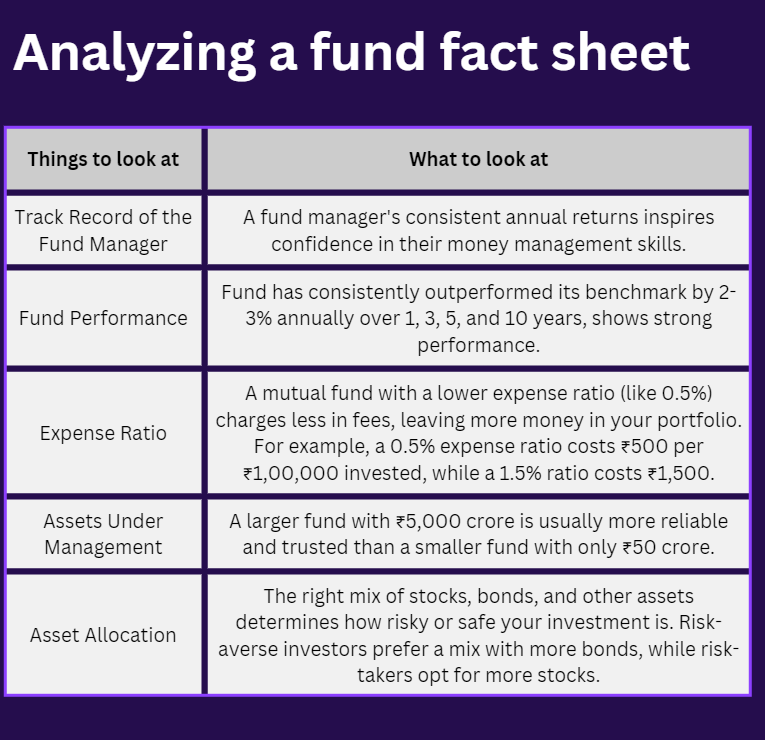
To make informed investment decisions, understanding a fund fact sheet is essential. Here are key aspects to consider:
Track Record of the Fund Manager
Think of the fund manager as the captain of a ship. A captain with years of successful voyages is more likely to navigate through storms and calm seas alike. For instance, if a fund manager has consistently delivered 10-12% annual returns over the past decade, similar to a reliable train arriving on time, it instills confidence in their ability to manage your money effectively.
Fund Performance
Evaluating a fund’s performance is like checking a car’s mileage before buying it. Look at how the fund has performed over 1, 3, 5, and 10 years. Suppose the fund has consistently outperformed its benchmark, such as the Nifty 50, by 2-3% annually. This is akin to finding a car that not only runs smoothly but also gives better mileage than expected, proving its efficiency and reliability.
Expense Ratio
The expense ratio is the cost of keeping your investment running, similar to maintenance fees for a vehicle. If two mutual funds are like two different car models, one with an expense ratio of 1.5% and another with 0.5%, the latter leaves more fuel (returns) in your tank (portfolio). For example, a fund with an expense ratio of 0.5% means that for every ₹1,00,000 invested, ₹500 is used for management fees, compared to ₹1,500 for a 1.5% ratio.
Assets Under Management (AUM)
AUM is like the number of passengers trusting a bus service. A higher AUM indicates a bus full of passengers, reflecting its popularity and trustworthiness. For instance, a fund managing ₹5,000 crore is generally more stable and trusted by investors compared to a fund with only ₹50 crore, just as a busier bus route often indicates a reliable service.
Asset Allocation
Imagine asset allocation as the ingredients in a recipe. The right mix of stocks, bonds, and other assets ensures the dish suits your taste (risk tolerance and goals). For example, if you are risk-averse, you might prefer a fund with 70% in bonds and 30% in stocks, akin to a dish with more mild ingredients for a subtle flavor. Conversely, a risk-taker might opt for 70% in stocks, akin to a spicy, adventurous recipe.
Understanding these components helps you choose a fund that aligns with your financial goals and risk appetite, ensuring a well-informed and confident investment decision.
Steps to Build Wealth with Mutual Funds
- Set Financial Goals: Define your short-term and long-term goals.
- Choose the Right Funds: Based on your goals and risk tolerance, select suitable mutual funds.
- Regular Investments: Use SIPs (Systematic Investment Plans) to invest regularly, benefiting from rupee cost averaging.
- Monitor Performance: Regularly review your portfolio and make adjustments as needed.
- Seek Expert Advice: Utilize platforms like Cashvisory for expert guidance and insights.
Conclusion
Mutual funds offer a robust way to build wealth through professional management, diversification, and adaptability to market conditions. By understanding how to select and manage your investments, you can harness the full potential of mutual funds. To dive deeper into the benefits and strategies of mutual fund investing, subscribe to the Cashvisory newsletter or watch our informative YouTube videos. Start your journey towards financial growth and security today.