
Key Takeaways
- Protect Your Wealth : Understanding and using a glide path helps shield your investments from market volatility as you approach your financial goals.
- Dynamic Adjustment : A glide path strategy involves gradually shifting from high-risk to low-risk investments over time, balancing growth and protection.
- Accessibility : Platforms like Cashvisory automate the glide path process, making it easy for anyone to implement this strategy and manage their wealth effectively.
- Long-Term Planning : Implementing a glide path is ideal for long-term financial goals, such as retirement or saving for a child’s education, ensuring that your savings are preserved and grow steadily.
Explore more on Cashvisory to start your journey towards smarter, safer investing today!

Understanding the Glide Path
Building wealth is a long-term journey, and protecting that wealth from market volatility is crucial. One effective strategy for managing this journey is understanding and utilizing the “glide path.” While the term might sound complex, it’s simply about adjusting your investments over time to reduce risk as you get closer to your financial goals.
Why Is the Glide Path Worth Understanding?
Understanding the glide path is essential for anyone looking to safeguard their wealth, particularly as they approach significant financial milestones, like retirement. Here’s why the glide path is crucial and how it addresses the risks associated with long-term investments:
Preventing Wealth Erosion
The primary goal of a glide path is to prevent wealth erosion caused by market fluctuations. As you get closer to your retirement or another financial goal, your ability to recover from market downturns diminishes. The glide path strategy involves gradually shifting your investments from higher-risk assets, like stocks, to lower-risk ones, such as bonds and cash equivalents. This transition helps protect your accumulated wealth from unexpected market drops.
Managing Market Volatility
Market volatility is an inherent part of investing. While markets generally trend upward over the long term, they also experience periods of significant ups and downs. For long-term goals, such as retirement, the risk isn’t just the volatility itself but the timing of that volatility.
Imagine you’re heavily invested in stocks, and the market crashes just as you’re about to retire. This scenario could drastically reduce your portfolio’s value, affecting your retirement plans. A well-structured glide path mitigates this risk by reducing your exposure to volatile assets as you near your goal, ensuring that your investments are more stable and less susceptible to sudden market changes.
Long-Term Investment Risks
Investing for long-term goals comes with several risks, including:
- Market Risk: The possibility that your investments will lose value due to overall market declines.
- Sequence of Returns Risk: The risk of receiving poor returns early in your retirement, which can deplete your savings faster than expected.
- Inflation Risk: The risk that inflation will erode your purchasing power over time.
- Interest Rate Risk: Changes in interest rates can affect the value of your bonds and other fixed-income investments.
By understanding and implementing a glide path, you can better manage these risks. The glide path strategy aims to balance growth and preservation, adapting your asset allocation over time to match your changing risk tolerance and investment horizon.
Volatility at the End of the Investment Period
Market volatility can be particularly damaging at the end of your investment period. This is because you have less time to recover from losses. Here’s why this matters:
- Withdrawal Timing: If you need to start withdrawing from your investments during a market downturn, you might have to sell assets at a loss, locking in those losses.
- Reduced Growth Potential: Significant market drops can reduce the overall growth of your portfolio, limiting the funds available during your retirement.
By transitioning to lower-risk assets as you approach your goal, a glide path helps to ensure that your portfolio remains stable, reducing the impact of any late-stage market volatility.
Basics of the Glide Path
A glide path is essentially an investment strategy that adjusts the mix of assets in your portfolio over time. Here’s a basic rundown:
Start with Higher Risk : When you’re far from your goal, your portfolio is more heavily invested in higher-risk, higher-reward assets, such as stocks. This approach leverages the longer time horizon, allowing you to take advantage of the potential for greater returns, as you have more time to ride out market fluctuations and recover from any downturns.
Shift to Lower Risk : As you approach your goal, you gradually shift towards lower-risk investments such as bonds or cash equivalents.
Why Is a Glide Path an Optimal Choice?
The glide path strategy is optimal because it balances the need for growth with the need for protection. Early on, you capitalize on the higher growth potential of stocks. Later, you protect your gains by moving to safer investments. This method helps mitigate the impact of market volatility on your savings.
Examples of Glide Paths for Common Investment Journeys
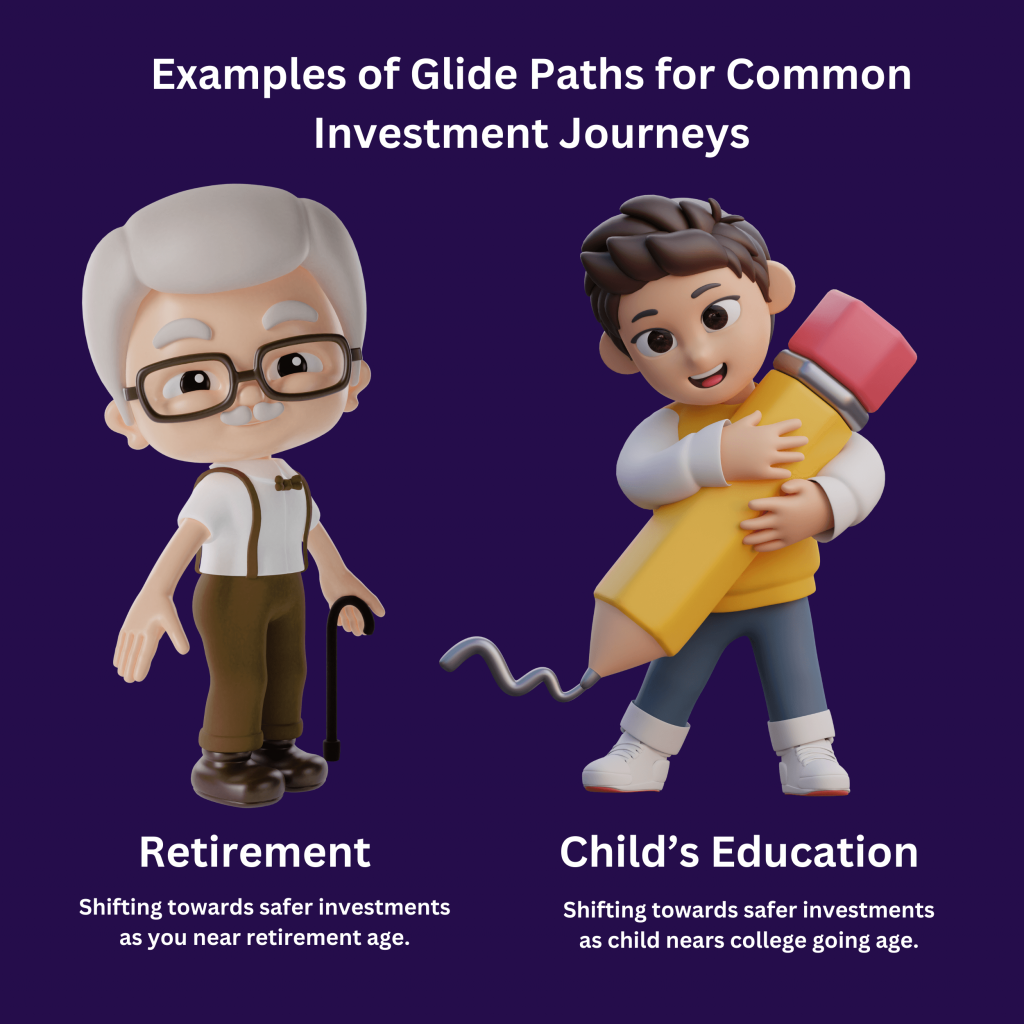
Let’s look at two common investment journeys: retirement planning and saving for a child’s education.
1. Retirement Planning
- Early Career (20-35 years old) : Primarily invest in stocks (80-90% of your portfolio) because you have time to recover from market dips.
- Mid-Career (36-50 years old) : Start shifting to bonds and other safer investments (60-70% stocks, 30-40% bonds).
- Pre-Retirement (51-65 years old): Continue reducing stock exposure (30-50% stocks, 50-70% bonds).
- Retirement (65+ years old) : Focus on capital preservation (20-30% stocks, 70-80% bonds/cash).
2. Saving for a Child’s Education
- Early Years (Birth-10 years old) : Heavily invest in stocks (70-80%) for higher growth.
- Middle School Years (11-15 years old) : Gradually add bonds to the mix (50-60% stocks, 40-50% bonds).
- High School Years (16-18 years old) : Shift towards safety (20-30% stocks, 70-80% bonds).
Maintaining a Steady Investment Approach
An important aspect of a successful glide path is maintaining a steady and disciplined investment approach. Consistency in investing can help smooth out the impacts of market volatility and ensure continuous growth. One effective strategy for achieving this consistency is dollar-cost averaging (DCA).
Dollar-Cost Averaging: A Steady Approach to Investing
Dollar-cost averaging (DCA) is one crucial strategy to be considered as part of a glide path. This involves regularly investing a fixed amount of money into a particular investment, regardless of its price.
Suppose Rahul decides to invest 5,000 rupees into a mutual fund every month using dollar-cost averaging (DCA).
- Month 1: The mutual fund’s price per unit is 100 rupees. Rahul’s 5,000 rupees investment buys him 50 units.
- Month 2: The price per unit rises to 120 rupees. With his 5,000 rupees, Rahul now buys approximately 41.67 units.
- Month 3: The price per unit drops to 80 rupees. Rahul’s 5,000 rupees investment now buys him 62.5 units.
- Month 4: The price per unit remains at 80 rupees. Rahul buys another 62.5 units.
- Month 5: The price per unit increases to 110 rupees. Rahul’s 5,000 rupees now buys him approximately 45.45 units.
Over time, regardless of the fluctuations in the market, Rahul consistently invests 5,000 rupees each month. When prices are higher, he buys fewer units, and when prices are lower, he buys more units. This approach helps Rahul benefit from the long-term growth potential of the market while reducing the impact of market volatility on his investment portfolio.
Actionable Ways to Create a Glide Path
Creating a glide path for your investments is straightforward with the right tools and guidance. Here’s how you can do it:
1. Assess Your Time Horizon
First, determine how long you have until you need to use the money. This time horizon is crucial because it dictates how aggressively you should invest initially. For example, if you’re planning for retirement 30 years from now, you can afford to take on more risk in the early years. However, if you’re saving for a child’s college education that begins in 10 years, a more conservative approach is warranted from the start.
2. Initial Asset Allocation
Based on your time horizon, begin with a higher allocation in stocks if you have a long time before you need the funds. Stocks generally offer higher returns over the long term but come with higher volatility. A typical starting point for a long-term investor who is an adventurous investor, that is, a risk lover, might be 80-90% in stocks and 10-20% in bonds or other low-risk assets. This initial allocation allows your investments to grow significantly during the early years.
3. Regular Adjustments
As you get closer to your goal, periodically adjust your portfolio to gradually decrease stock exposure and increase bond exposure. This process, often referred to as “rebalancing,” helps reduce risk and protect the gains you’ve accumulated. For example, if you start with 80% in stocks and 20% in bonds, you might shift to 70% stocks and 30% bonds as you approach the midpoint of your investment horizon, and eventually to 50% stocks and 50% bonds as you near your goal.
4. Automate the Process
To make this process easier and more efficient, use investment platforms like Cashvisory that offer automation tools. These platforms can automatically adjust your asset allocation based on your predefined glide path, ensuring a seamless transition without constant manual intervention. Automation helps maintain discipline in your investment strategy and reduces the emotional decision-making that can lead to poor investment choices.
By following these steps, you can create a personalized glide path that helps protect your wealth from market volatility while still achieving your long-term financial goals. Using platforms like Cashvisory makes the process straightforward and accessible, ensuring that even casual investors can manage their investments effectively.
Conclusion
Understanding and implementing a glide path can significantly enhance your ability to protect your wealth from market volatility.
By adjusting your investment strategy over time, you can balance growth and risk, ensuring your hard-earned money is safeguarded.
Dive deeper into this strategy and explore more ways to manage your wealth effectively with Cashvisory.
Your financial journey deserves the best tools and guidance to achieve your long-term goals.
Explore more on Cashvisory and start your journey towards smarter, safer investing today!